What the photographs taught me
Color in the mountains is never just a swatch.
The longer I looked, the more each color changed with the thing carrying it. Blue could sit deep in mushroom gills, flicker across a fish, or soften into four tiny petals. White could feel waxy, translucent, or lit from within. These are eight details that changed how I see Appalachian color—and what I bring back to the studio.
Red
A red berry with two small beginnings.
Look closely at Partridgeberry and the fruit carries two tiny dimples—a trace of the paired flowers that came before it.
Both flowers have to be pollinated before one scarlet berry forms. Later, that bright red helps the fruit stand out against glossy green leaves and the dark forest floor.
NC State Extension → · U.S. Forest Service →
Orange
Orange can mean bloom, fungus, or warning.
An Eastern Newt wears its brightest orange while traveling through the woods; as an aquatic adult, it settles into olive green.
The orange eft is easy to see and difficult to ignore, a warning carried in skin. Nearby, azalea petals, jewelweed, waxcaps, and Chicken of the Woods arrive at neighboring oranges in entirely different ways.
U.S. Geological Survey → · University of Utah →
Yellow
Autumn yellow was hiding inside the leaf.
When green chlorophyll fades, yellow and orange pigments that were already present finally become visible.
The same pigments help a living leaf manage sunlight. Across the mountains, yellow also appears in flower cells, mushroom flesh, pore surfaces, and thousands of overlapping butterfly scales—similar color, completely different surfaces.
USDA Forest Service → · University of Kentucky →
Green
A green lichen is a small shared life.
The broad green patch on a rock is not one organism working alone: a fungus makes shelter while algae inside use sunlight to make food.
That partnership becomes the greenshield spreading across the stone. Look closer still and a lichen can contain yeasts and bacteria too—a whole community flattened into what first seems like one quiet color.
U.S. Forest Service → · Missouri Department of Conservation →
Blue
Blue changes when the surface changes.
The Indigo Milk Cap makes its own deep blue. A sunfish flashes turquoise because tiny reflective layers in its skin catch and return the light.
That is why fish color seems to move as the body turns: blue slips into olive, gold, or green with the angle. Flowers reach powder blue and violet through pigments and petal structure, while water and sky add their own reflected color around everything.
Smithsonian → · Research on blue anthocyanin color →
Violet
A flower looks different to a bee.
Bees see ultraviolet as well as blue and green, so a bloom can carry markings that are invisible to me.
Petal shape, surface, scent, nectar, background, and angle all become part of the invitation. What I call violet is only one view of a much larger signal passing between flower and visitor.
Floral optics and pollinator vision → · Flower-color chemistry →
White
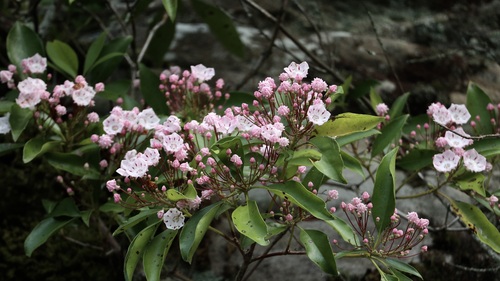
White is full of small shadows.
A white petal can look luminous because light keeps meeting cell walls and tiny air spaces, then scatters back toward the eye.
Change the thickness or surface and white becomes waxy, papery, translucent, or warm cream. Veins, curled edges, shaded centers, and reflected green from nearby leaves keep it from ever being blank.
American Journal of Botany → · Royal Botanic Gardens, Kew →
Black
Dark color can protect a fungus.
Some fungi build melanin into their cell walls, making the dark surface part color and part protection.
It can help cells withstand drying, radiation, temperature swings, and chemical stress. Elsewhere, darkness comes from black fur, wet bark, dense spores, deep water, or simple shade—each with its own kind of black.
Review of fungal melanin → · National Park Service →